Notes on memory architecture, retrieval experiments, and Eney-style memory evaluation.
Mnemos eval
Primary benchmarks: HippoCamp-Chat v0.8.8 is the frozen cross-modal target, pairing HippoCamp's personal files with multi-session user-agent chats and tool trajectories. LongMemEval-v1 complements it with explicit chat-memory evaluation.
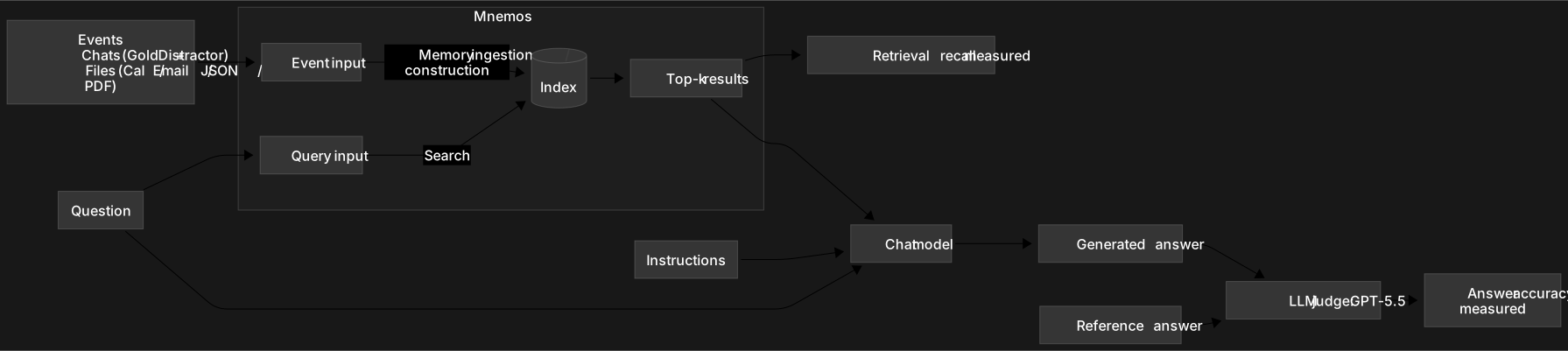
Metrics and diagnostics: final-answer accuracy is the headline metric, while all-evidence recall diagnoses retrieval. HippoCamp, MemConflict, HaluMem, and DynamicMem provide secondary checks for temporal updates, conflict handling, hallucination, and user modeling.
Dataset scale reference
Dataset
Size GB
Questions
Evidence units / question avg | median
Searchable units / question avg | median
Turns / session avg | median
Comments
LongMemEval-S
0.28
500
1.90 | 2 sessions
47.73 | 48 sessions
10.34 | 12
Released S split; supporting and distractor sessions share the same searchable timeline.
LongMemEval-M
2.74
500
1.90 | 2 sessions
475.31 | 476 sessions
10.30 | 12
Same questions and supporting sessions as S, with roughly 10× more distractor history.
HippoCamp Gold
0.53
581
4.28 | 1 files
643.67 | 711 files / persona
N/A
File-based benchmark; Victoria's finance corpus drives the high searchable mean.
HippoCamp-Chat-S v0.8.8
0.0014
60 50 answerable 10 no-answer
2.48 | 2 1.36 chats + 1.12 durable
621 | 689 49.53 chats + 571.02 files
11.26 | 10
One consolidated S benchmark across three persona timelines. Answerable cases require 2.48 annotated units on average. At each query timestamp, the memory searches about 621 visible units: 49.53 chats and 571.02 durable files on average.
1 Sizes use the released cleaned JSON for LongMemEval, the parsed-text HippoCamp Gold corpus, and the locked HippoCamp-Chat v0.8.8 JSON payload. HippoCamp-Chat excludes its inherited files. A turn is one user or assistant message. 2 HippoCamp-Chat exceeds LongMemEval-S in total file + cutoff-visible-chat units and closely matches its conversational interference at 49.53 visible chats per question. Files and chat sessions are not equivalent retrieval units. 3 Early queries see less history; later queries approach all 90 chats in their persona timeline.
Benchmark composition
The frozen release contains 60 questions, 270 user-assistant chats, and 1,931 durable files. Of the chats, 68 are gold evidence and 202 are constraint-checked distractors.
Dimension
Distribution
Personas
Adam: 22; Bei: 18; Victoria: 20
Answerability
Answerable: 50; no-answer: 10
Difficulty
Easy: 23; medium: 31; hard: 6
Evidence shape
1 chat + 1 source: 33; 2 chats + 1 source: 12; four or more evidence units: 5
Known limitations. Chats and tool outputs are synthetic approximations, and gold-chat assistant turns are less verbose than production assistants. The locked release should remain unchanged while memory designs are compared.
Experiment design - Mnemos on HippoCamp-Chat
Results timeline
The main view is the chronological experiment record. Each dot is an indexed attempt; the most important repeated arms are highlighted with their mean and ±1 SD. Hover or select a dot for the result details, then open Archive when you need the full audit trail.
Experiment historyAnswer accuracy by indexed attempt; repeated arms show ±1 SD
Select a point to inspect its configuration, verified metrics, and known gaps.
Experiment results
Architecture variants, lexical screens, and evidence ceilings share a 12K-character pack cap. Accuracy is over 50 answerable cases per trial; gold-supplied rows have no retrieval metrics. Experiment audit log.
Answer model: Qwen3.8-27B (thinking ON, medium). GPT-5.5 (medium) judges accuracy only. Qwen ingestion and query planning use thinking OFF. A generated summary paraphrases and condenses its source; key spans stay verbatim.
Main Mnemos architecture and evidence diagnostic results
Experiment
Variant / condition
Accuracy mean ± sample SD; trials
Reader context tokens p50; avg records/question
Index size
Latency breakdown evidence build; final-Qwen TTFT, generation and decode rate; E2E p50 / p95 / mean
Recall all / any
MRR
Evidence-quality upper bounds
EXP-085
Exact gold evidence; retrieval bypassed
91.3% ± 3.1 n=3; 88–94%
549.5 [284–1,800]; ~2 records
N/A (no index)
Context: N/A (fixed pack supplied)TTFT: 0.122 s / 0.320 sDecode: 7.693 s / 27.543 sE2E: 7.811 s / 27.858 s
N/A (gold supplied)
N/A (retrieval bypassed)
EXP-092
Gold + 8 random distractors
85.3% ± 2.3 n=3; 84–88%
2,931.5 [2,439–3,961]; ~14 records
N/A (no index)
Context: N/A (fixed pack supplied)TTFT: 0.343 s / 0.660 sDecode: 10.632 s / 43.040 sE2E: 10.967 s / 43.804 s
N/A (gold supplied)
N/A (retrieval bypassed)
EXP-083
Gold + actual retriever candidate setRealistic upper bound (gold injected)
77.3% ± 5.0 n=3; 72–82%
2,992.5 [2,234–4,659]; ~12 records
558 MB
Context: N/A (prebuilt candidate + gold pack)TTFT: 0.354 s / 0.733 sDecode: 11.010 s / 47.953 sE2E: 11.350 s / 48.665 s
N/A (gold injected)
N/A (gold injected)
EXP-098
Gold + LLM-selected hard negatives
82.7% ± 5.0 n=3; 78–88%
2,819.5 [2,234–3,696]; ~11 records
N/A (no index)
Context: N/A (fixed pack supplied)TTFT: 0.335 s / 0.766 sDecode: 11.684 s / 49.375 sE2E: 11.988 s / 50.206 s
N/A (gold supplied)
N/A (retrieval bypassed)
Mnemos architecture progression
Dense-rawEXP-073
Raw-source dense retrieval + BGE rerank
41.3% ± 1.2 n=3; 40–42%
2,969.5 [1,464–4,420]; ~8 records
558 MB
Context: 1.788 s / 7.864 sTTFT: 0.363 s / 0.741 sDecode: 12.204 s / 54.140 sE2E: 16.478 s / 55.824 s
Serving: Measured on 1 AMD GPU; vLLM 0.19.1, BF16, TP=1, 32K max context, 90% GPU memory. For EXP-119–121, evidence-build includes any planner/controller call; TTFT and generation are final-Qwen only. Decode is throughput (tok/s), not duration. New-run p95/mean shown are end-to-end aggregates.
Architecture accuracy vs latency
End-to-end p50 on a zero-based 0–25 second scale. The BM25 screens have one trial each; Mnemos variants have three. Horizontal references show EXP-083, the realistic upper bound with gold injected into retrieved candidates, and EXP-085, the exact-gold reader ceiling.
Mnemos · three trialsBM25 · one trialEXP-083 · realistic upper bound · 77.3%EXP-085 · 91.3% upper bound
Design FAQs (answered by experiments)
Ingestion and summaries
Does summarizing at ingestion help?
Yes in the lexical screen: BM25-raw 4% to BM25-Summary 26%; the summary source index is much smaller than the raw corpus. EXP-125/126
What summary length worked best?
The fixed 300-token cap beat the uncapped version in the decomposition comparison, 54.0% versus 44.7%. Very short summaries were weaker in earlier screens. EXP-121/123, EXP-064/066
Do verbatim spans help?
They help preserve exact source language, but larger records reduce coverage under the same pack cap; hybrid plus decompose scored 51.3%, below Query-Decompose's 54.0%. EXP-119/121/124
What happens to long documents?
The current ingestion path compresses each source to one summary after a 12K-character input cap. Details beyond that cap can be lost. Index-building code
Should we chunk long sources instead of truncating them at ingestion?
No. We tested both concatenated chunk summaries and the intended design: one independently searchable record and embedding per chunk. Both lose. The corrected per-chunk design is 2 to 7 points lower in accuracy and 4 to 16 points lower in all-evidence recall than the non-chunked twins. Splitting long documents lets a few large sources flood the reranker's top-k with near-duplicate shards, often 5 to 7 chunks from one source in the top 10. That crowds the second source a multi-hop question needs out of the 12K pack. Recall falls while conversion stays flat. Read-Retrieve is hit worst, so its follow-up rerank does not rescue it. Truncate-then-summarize remains the default. A viable chunked design needs a per-source candidate cap of about 3 to 4 records and/or a source-level summary with capped chunk expansion. EXP-132/133/134 vs EXP-119/120/121
Retrieval
Dense or BM25?
Dense-raw scored 41.3% across three trials; BM25-raw scored 4.0% in one trial. The gap is large, though trial counts differ. EXP-073/125
Does reranking help?
Adding BGE to BM25-Summary raised this single-trial screen from 26% to 36%. EXP-126/127
Is ranking the main bottleneck?
MRR stays around 0.86–0.88 in the summary arms, while all-evidence recall varies more; coverage looks more limiting than first-hit rank here. EXP-119/120/121
Upfront decomposition or read-then-retrieve?
Both beat the single-pass Summary-Dense arm; Read-Retrieve scored 56.0% at 16.6 s p50, Query-Decompose 54.0% at 18.7 s, within three-trial noise. EXP-119/120/121
Coverage and packing
Which recall matters?
Multi-source questions need all required evidence. The table reports both all-evidence and fractional unit coverage of the final reader pack. EXP-119/120/121
How much fits in 12K characters?
About 8 raw parents, 11–12 hybrid records, 14 abstractive summaries, or 24 fixed-length summaries per question. EXP-073/119/120/121
Does a fuller compact pack help?
Earlier k8-to-k16 fixed-summary runs improved answer accuracy; the completed Query-Decompose arm packs about 24 records on average. EXP-077/121
Can richer summaries eliminate the coverage tradeoff?
Not in this sweep: the short-span, hybrid, and uncapped decomposition arms all scored at or below the fixed-summary arm. EXP-121–124
Models and latency
Can off-the-shelf LFM replace Qwen for ingestion and planning?
Not yet in this test: the LFM-substituted arm scored about 30% versus Query-Decompose's 54%, with much lower evidence coverage. EXP-128/121
Is the controller the main latency cost?
No in these traces. Read-Retrieve's evidence build is 1.15 s p50 versus 15.2 s final-Qwen generation; the final reader dominates. EXP-119
Productionization
Won't chunking long sources let a few big documents dominate the index or context?
Yes. Chunking avoids truncation but can crowd the reranked top-k with records from one long source, leaving out the other source a multi-hop question needs. Use two inexpensive diversity gates: cap ingestion at about 12 chunks per source, then cap the final pack at about 3-4 records per source after reranking. No extra model calls are needed. Add length-normalized retrieval scoring or a hierarchical index with an always-kept source summary and capped chunk expansion only if source domination becomes a major failure pattern.
Qwen ingestion and retrieval prompts
Verbatim prompt templates from cluster checkout mnemos-w10-compose-16c4ed5. Braced names are runtime substitutions, not literal prompt text.
Write the densest possible factual summary of this source in UNDER 90 WORDS:
the shortest text that still preserves every fact a later question could
depend on (names, dates, numbers, decisions, preferences, events). If the
source contains more facts than fit in 90 words, keep the most specific,
answer-bearing ones and drop the rest rather than exceeding the budget.
Paraphrase freely for density, but do not add anything not present in the
text and do not drop a fact you have room for. Output plain text only, no
markdown headers, no preamble or commentary - just the summary itself.
Write the densest possible factual summary of this source: the shortest
text that still preserves every fact a later question could depend on
(names, dates, numbers, decisions, preferences, events). Paraphrase freely
for density, but do not add anything not present in the text and do not
drop a fact to save space. Output plain text only, no markdown headers, no
preamble or commentary - just the summary itself.
You plan the only opportunity to query a chronological personal-memory index for another model.
After this response, your searches run concurrently. You will not see their results, revise the plan,
inspect neighbors, or issue another query. Do not answer the user's question.
Return only JSON with exactly this schema:
{"searches":[{"query":string,"k":integer}]}
Rules:
- Produce between 1 and {max_queries} distinct searches.
- The first query must reproduce the user's exact original question, character for character.
- Choose k independently for every query from 1 to {max_k}.
- Use additional searches to cover independent answer facets, entities, aliases, dates, events, or lexical
  bridges that the exact question may miss. Because this is your only shot, cover plausible facets now.
- Prefer small k for precise lookups and larger k for broad or ambiguous facets.
- Do not invent personal facts, names, dates, or relationships absent from the question.

User: Original question:
{question}
Plan focused retrieval queries for a locked memory benchmark. Return only JSON with
exactly this schema: {"queries":[string],"stop":boolean}. Emit at most {max_queries}
new queries. Set stop=true and queries=[] only when the evidence is sufficient. Do not
answer the question and do not include claims not present in the question or evidence.

User: Question:
{question}

Already used queries:
{used_queries}

Retrieved raw evidence:
{evidence}
EXP-083: gold injected into the normal top-k retriever candidate set; remaining retrieved hits become natural distractors, with the per-query count varying under the 12K-character cap.
EXP-084: gold evidence plus abstractive, model-generated distractor summaries.
EXP-085: exact gold evidence; the reader ceiling with retrieval bypassed.
EXP-086–089: gold evidence plus 2, 4, 8, or 16 deliberately hard negatives.
EXP-090–093: gold evidence plus 2, 4, 8, or 16 random distractors.
EXP-094–097: retrieved-distractor packs at recall depths k=40/60/80/100; the low points show what happens before enough evidence is recovered.
EXP-098: gold evidence plus LLM-selected hard near-miss negatives.
EXP-099: the gold passage represented as its real retrieved chunk, isolating chunk-boundary effects.
The remaining coloured points are the retrieval, ingestion, and architecture sweep; failed and superseded attempts are in Archive.
Top five architecture candidates
These are the most useful non-oracle candidates from the exploration so far, ranked by confirmed accuracy and practical promise. The repeated arms matter more than the isolated 56% peaks from EXP-068/078, which were not independently confirmed.
01
EXP-11956.0% ± 3.5 · 3 trials
Hybrid summary + read-then-retrieve
Qwen builds a compact source summary plus two or three verbatim key spans. Mnemos performs dense retrieval and BGE reranking, then a Qwen controller writes one follow-up query for missing evidence.
AER @12K
64.0%
Unit recall
84.0%
Context p50
3,022 tokens
E2E p50
16.6 s
02
EXP-10454% · 3 trials
Smart hybrid + read-then-retrieve
The same compressed source index and one-hop controller, but the summary keeps query-relevant spans rather than a fixed span budget. It is the more selective, lower-context version of the hybrid recipe.
Recall
~70%
Context
2,361 tokens
E2E p50
12.9 s
03
EXP-10053% · 2 completed trials
Adaptive multi-hop retrieval
After the first retrieval, the controller sees the current evidence and emits both a follow-up query and a sufficient/stop decision. It can spend another hop only when the first pack appears incomplete.
Recall
55%
Context
1,208 tokens
E2E p50
10.3 s
04
EXP-10652.7% · 3 trials
Link-and-bridge index
At ingestion, Qwen extracts short cross-source tags and builds a lightweight link graph. At query time, linked partners of the top dense hits are added before BGE reranking, helping chat evidence reach its related file.
Recall
64%
Context
1,214 tokens
E2E p50
10.8 s
05
EXP-07152.7% · 3 trials
Raw-index read-then-retrieve
The cleanest test of the retrieval mechanism itself: raw parent records, dense retrieval and reranking, then one read-driven follow-up search. It works, but the uncompressed index and larger reader context make it the least efficient finalist.
Recall
~67%
Context
2,928 tokens
E2E p50
18.9 s
What the finalists have in commonRetrieval is improved before the final Qwen answerMermaid source
flowchart TD
  Q[User question] --> I[Compressed source index]
  I --> R[Dense or lexical retrieval + BGE rerank]
  R --> L[EXP-106: linked partners before rerank]
  R --> A[EXP-100: adaptive follow-up query or stop]
  R --> H[EXP-119/104: hybrid summary span selection]
  L --> P[Source-aware evidence pack]
  A --> P
  H --> P
  P --> O[Qwen answerer]
  O --> J[GPT-5.5 judge]
  X[EXP-071: raw-index read-then-retrieve] --> P
Reading this shortlist: EXP-119 is the strongest completed recipe under the shared 12K-character cap; EXP-074 remains its historical baseline. EXP-104 is the closest selective variant. EXP-100 and EXP-106 target recall directly at lower context cost. EXP-071 is the useful raw-record control that proves read-then-retrieve is doing real work, while also exposing its latency and index-size cost.
Supporting single-run results
These earlier point estimates fix Qwen3.8-27B as the answer model and GPT-5.5 as the independent judge. They remain useful for retrieval diagnostics, but the promoted three-trial study above is the more reliable performance comparison. Answer accuracy is over the 50 answerable tasks.
System / arm
Memory path
Answer accuracy
Recall @20 all sources
Mean source recall
MRR
Median context build
Median Qwen answer
Median end-to-end
Comments
Hindsight iterative
Native Hindsight + Qwen controller
52%26/50
0%
28.2%
0.44
210 s
39 s
253 s
Up to six native searches and 20 retained records, with strict query-time filtering.
Mem0 iterative
Native Mem0 + Qwen controller
42%21/50
0%
28.7%
0.40
135 s
33 s
175 s
Up to six native searches and 20 retained records.
Mnemos iterative FTS
FTS5/BM25 + Qwen controller
26%13/50
62%
81.7%
0.84
165 s
57 s
242 s
Iteration improves source coverage, but often retains the wrong passage from a correct parent source.
Mnemos iterative FTS + pseudo-QA
Pseudo-QA ingestion + Qwen controller
20%10/50
38%
57.5%
0.72
137 s
35 s
177 s
Combining pseudo-QA with iteration did not compound their separate gains.
Hindsight
Native pipeline
32%16/50
18%
46.5%
0.63
N/A
129 s
N/A
Context-construction timing was not recorded. Semantic and keyword retrieval plus local reranking returns about 8.5 coherent items at the median.
Mem0
Native extraction and retrieval
26%13/50
22%
55.2%
0.63
N/A
132 s
N/A
Context-construction timing was not recorded. Sonnet 5 extracts atomic chat memories; durable files remain overlapping raw chunks.
Mnemos FTS
Sentence FTS5/BM25
14%7/50
44%
68.3%
0.61
0.1 s
101 s
101 s
Raw-record baseline with 20 retrieved records. Almost all measured latency is Qwen answer generation.
Exact gold evidence
Retrieval bypassed
88%44/50
N/A
N/A
N/A
N/A
35 s
35 s
Reader upper bound using the same Qwen answerer and GPT-5.5 judge. The remaining errors are downstream synthesis or answer-quality failures.
Timings are medians over the recorded evaluation queries. Context build includes controller inference and index search through the final packed evidence. Qwen answer is the wall-clock latency of the batch containing each query; end-to-end is computed per query as context build plus that batch latency, so it is not the sum of the displayed medians. GPT-5.5 judging is excluded. All current rows abstain on 10/10 no-answer tasks.
Appendix: reliable three-trial resultsaccuracy, latency, recall, and confidence intervals
Three-trial accuracy and latency results
Arm
Accuracy mean ± SD; range
Context build mean [95% CI]
Qwen answer mean [95% CI]
End-to-end mean [95% CI]
Exact gold evidence Sonnet reader: 88% (44/50)
91.3% ± 3.1; 88–94% Qwen reader; Sonnet is similar
0.0 s [0.0, 0.0]
25.4 s [22.5, 28.8]
25.4 s [22.5, 28.8]
Mem0 native
27.3% ± 1.2; 26–28%
5.7 s [4.9, 6.5]
40.3 s [35.5, 45.3]
46.0 s [41.1, 51.2]
Mem0 one-shot parallel
22.0% ± 2.0; 20–24%
39.8 s [34.6, 45.3]
36.7 s [32.3, 41.3]
76.5 s [69.0, 84.5]
Mem0 Planned-Select
32.7% ± 2.3; 30–34%
58.4 s [52.3, 64.9]
33.5 s [29.2, 38.1]
91.9 s [83.2, 100.9]
Mem0 iterative
44.7% ± 1.2; 44–46%
130.7 s [121.8, 139.9]
24.6 s [20.6, 29.0]
155.3 s [144.4, 166.6]
Mem0 parallel iterative
35.3% ± 1.2; 34–36%
181.4 s [166.1, 197.3]
32.6 s [28.1, 37.7]
214.0 s [196.5, 232.5]
Mem0 Qwen-ingested native
21.3% ± 3.1; 18–24%
5.7 s [4.9, 6.6]
45.8 s [39.8, 52.1]
51.6 s [45.4, 57.9]
Mem0 Qwen-ingested Planned-Select
26.0% ± 4.0; 22–30%
58.4 s [52.2, 64.6]
34.1 s [29.8, 38.6]
92.4 s [84.3, 100.8]
Mem0 Qwen-ingested iterative
36.7% ± 1.2; 36–38%
147.2 s [137.8, 156.9]
37.9 s [33.0, 43.0]
185.2 s [173.3, 197.1]
Hindsight native
25.3% ± 5.0; 20–30%
28.8 s [22.5, 32.6]
30.0 s [23.2, 36.2]
58.8 s [46.1, 68.5]
Hindsight one-shot parallel
15.3% ± 9.5; 8–26%
72.6 s [60.6, 83.9]
22.7 s [15.5, 30.9]
95.4 s [77.6, 112.4]
Hindsight iterative
16.0% ± 2.0; 14–18%
111.4 s [86.5, 137.8]
13.7 s [11.1, 16.8]
125.1 s [98.5, 153.0]
Hindsight parallel iterative
16.7% ± 4.2; 12–20%
206.5 s [156.5, 261.4]
13.9 s [11.1, 17.1]
220.4 s [168.5, 276.8]
Mnemos FTS
16.0% ± 2.0; 14–18%
0.5 s [0.4, 0.6]
42.6 s [37.5, 48.3]
43.0 s [38.0, 48.7]
Mnemos one-shot parallel
14.0% ± 2.0; 12–16%
20.2 s [16.8, 24.1]
41.8 s [37.1, 46.7]
62.0 s [56.6, 67.6]
Mnemos iterative FTS
16.0% ± 2.0; 14–18%
141.2 s [131.4, 151.3]
24.8 s [20.8, 29.1]
166.0 s [154.5, 177.7]
Mnemos iterative FTS + pseudo-QA
21.3% ± 1.2; 20–22%
155.8 s [145.2, 166.6]
23.7 s [20.6, 27.1]
179.5 s [167.6, 191.5]
Qwen generic synopsis
14.0% ± 2.0; 12–16%
0.5 s [0.4, 0.6]
44.0 s [39.0, 49.1]
44.5 s [39.5, 49.6]
Qwen temporal ledger
14.7% ± 1.2; 14–16%
0.4 s [0.3, 0.5]
43.6 s [39.2, 48.4]
44.1 s [39.6, 48.9]
Qwen atomic cards
19.3% ± 2.3; 18–22%
0.4 s [0.3, 0.6]
41.6 s [37.1, 46.3]
42.0 s [37.6, 46.7]
Sonnet atomic cards
22.7% ± 1.2; 22–24%
0.4 s [0.3, 0.5]
48.4 s [42.6, 54.8]
48.8 s [43.0, 55.2]
Qwen retrieval anchors
20.0% ± 2.0; 18–22%
0.4 s [0.3, 0.5]
44.2 s [39.2, 49.4]
44.6 s [39.6, 49.9]
Qwen pseudo-QA cards
20.7% ± 3.1; 18–24%
0.4 s [0.3, 0.5]
40.8 s [36.5, 45.4]
41.3 s [36.9, 45.8]
Reproducibility note. The earlier 52% Hindsight-iterative point did not reproduce: these trials scored 14%, 16%, and 18%. Mem0 iterative was substantially more stable at 44%, 44%, and 46%, making it the strongest reproducible retrieval arm in this study. The new Qwen-ingested trials scored 18%, 24%, and 22% natively; 38%, 36%, and 36% with sequential iteration; and 26%, 22%, and 30% with Planned-Select. This isolates a real ingestion-quality advantage for the Sonnet-built Mem0 index while showing that iterative retrieval can recover part, but not all, of the gap.
Appendix: ingestion and historical comparisonssingle-run baselines, judge checks, and retrieval diagnostics
Current ingestion ablations
These arms keep native Mnemos sentence FTS fixed and append one kind of derived record at ingestion. Qwen3.8-27B answers every row and GPT-5.5 judges it; only the ingestion treatment varies.
Treatment
Ingestion model
Answer accuracy
Recall @20 all sources
Mean source recall
MRR
Median latency
Comments
Pseudo-QA cards
Qwen3.8-27B
24%12/50
42%
71.5%
0.66
117 s
Appends likely question-answer pairs. Best one-pass ingestion treatment despite slightly lower all-source recall than raw FTS.
Retrieval anchors
Qwen3.8-27B
20%10/50
44%
68.8%
0.62
106 s
Appends compact keywords and paraphrases intended to bridge likely query wording to each raw record.
Atomic memory cards
Claude Sonnet 5
20%10/50
42%
72.2%
0.71
123 s
Uses Sonnet only at ingestion; Qwen remains the answerer. Highest MRR among these ingestion treatments.
Atomic memory cards
Qwen3.8-27B
18%9/50
40%
68.8%
0.69
117 s
Breaks each source into compact standalone facts while retaining the raw record.
Temporal state ledger
Qwen3.8-27B
18%9/50
46%
71.7%
0.65
70 s
Extracts entity, attribute, value, and validity time. Retrieval improves more than final answer accuracy.
Generic synopsis
Qwen3.8-27B
14%7/50
42%
68.0%
0.62
68 s
General summaries do not improve answer accuracy over raw records.
Raw records
None
14%7/50
44%
68.3%
0.61
103 s
Control arm. Derived representations help only when their structure matches likely queries.
Latency is median end-to-end time per answerable query and excludes judging. Ingestion cost and one-time index construction are not included.
Judge sensitivity: Qwen self-judging
The candidate answers are identical in both columns. GPT-5.5 is the primary judge; Qwen self-judging was generally more permissive and is retained only as a diagnostic.
System / treatment
GPT-5.5 judge
Qwen judge
Difference
Hindsight iterative
52%
58%
+6
Mem0 iterative
42%
42%
0
Hindsight
32%
38%
+6
Mem0
26%
36%
+10
Mnemos iterative FTS
26%
32%
+6
Mnemos iterative FTS + pseudo-QA
20%
22%
+2
Mnemos FTS
14%
16%
+2
Qwen pseudo-QA cards
24%
26%
+2
Qwen retrieval anchors
20%
26%
+6
Sonnet atomic cards
20%
26%
+6
Qwen atomic cards
18%
22%
+4
Qwen temporal ledger
18%
18%
0
Qwen generic synopsis
14%
18%
+4
Historical Sonnet / GPT-5.5 results
These earlier v0.8.8 runs use Claude Sonnet 5 as final reader and GPT-5.5 as judge. Because the judge is now fixed, they provide a direct answer-model sensitivity comparison with the current Qwen-reader results.
Memory system
Retrieval / memory path
Answer model
Answer accuracy
Hindsight
Native pipeline
Claude Sonnet 5
26%13/50
Mem0
Native pipeline
Claude Sonnet 5
22%11/50
Mnemos FTS
Sentence FTS5 / BM25
Claude Sonnet 5
14%7/50
Honcho
Native pipeline
Claude Sonnet 5
0%0/50
HippoCamp-Chat v0.8.8 contains 50 answerable and 10 no-answer tasks. Retrieval is capped at k=20 and answer context at 12,000 characters. All four systems abstained correctly on 10/10 no-answer tasks. Honcho retrieved relevant evidence in only 3/50 answerable cases, so its 0% result primarily reflects retrieval failure.
Mnemos ingestion ablations
Appending model-generated memory records at ingestion improves the native 14% FTS baseline. Qwen pseudo-QA cards perform best among the completed treatments.
Ingestion treatment
Ingestion model
Answer model
Answer accuracy
Raw records
None
Claude Sonnet 5
14%7/50
Atomic memory cards
Claude Sonnet 5
Claude Sonnet 5
20%10/50
Pseudo-QA cards
Qwen3.8-27B
Claude Sonnet 5
22%11/50
Atomic memory cards
Qwen3.8-27B
Claude Sonnet 5
18%9/50
Retrieval anchors
Qwen3.8-27B
Claude Sonnet 5
18%9/50
Generic synopsis
Qwen3.8-27B
Claude Sonnet 5
14%7/50
Temporal state ledger
Qwen3.8-27B
Claude Sonnet 5
14%7/50
All rows retain the same native Mnemos FTS retrieval and judging path. The best completed treatment raises answer accuracy by 8 points, from 14% to 22%; more expensive ingestion is therefore not sufficient by itself, and the representation format matters.
Answer-model and oracle ablations
Arm
Answer model
Purpose
Answer accuracy
Mnemos FTS
Claude Sonnet 5
Headline retrieval run
14%7/50
Mnemos FTS
LFM 24B, greedy
Answer-model sensitivity
12%6/50
Mnemos FTS
LFM 24B, sampled
T=0.1, top_k=50, repetition penalty 1.05
10%5/50
Mnemos FTS
LFM2.5-2.6B
Model-card inference settings
10%5/50
Exact gold evidence
Claude Sonnet 5
Reader upper bound
88%44/50
Exact gold evidence
LFM 24B, sampled
Reader upper bound
50%25/50
Exact gold evidence
LFM 24B, greedy
Reader upper bound
48%24/50
Exact gold evidence
LFM2.5-2.6B
Reader upper bound
36%18/50
Exact gold chat only
Claude Sonnet 5
Cross-modal leakage check
4%2/50
Exact gold chat only
LFM 24B, sampled
Cross-modal leakage check
4%2/50
Exact gold chat only
LFM 24B, greedy
Cross-modal leakage check
2%1/50
Exact gold chat only
LFM2.5-2.6B
Cross-modal leakage check
2%1/50
Exact gold non-chat only
Claude Sonnet 5
Cross-modal leakage check
4%2/50
Exact gold non-chat only
LFM 24B, sampled
Cross-modal leakage check
4%2/50
Exact gold non-chat only
LFM 24B, greedy
Cross-modal leakage check
4%2/50
Exact gold non-chat only
LFM2.5-2.6B
Cross-modal leakage check
6%3/50
Mnemos FTS, no chat distractors
Claude Sonnet 5
Retrieval control
12%6/50
Mnemos FTS, no chat distractors
LFM 24B, sampled
Retrieval control
8%4/50
Mnemos FTS, no chat distractors
LFM 24B, greedy
Retrieval control
8%4/50
Mnemos FTS, no chat distractors
LFM2.5-2.6B
Retrieval control
8%4/50
The exact-gold arms bypass retrieval. Low chat-only and non-chat-only accuracy indicates that most answerable tasks genuinely require both modalities. The no-chat-distractor control is diagnostic, not the benchmark setting.
Retrieval diagnostics
Memory system / arm
Answer accuracy
Recall @20 (all)
Mean source recall
MRR
No-answer abstention
Hindsight
26%13/50
18%
46.5%
0.63
10/10
Mem0
22%11/50
22%
55.2%
0.63
10/10
Mnemos FTS
14%7/50
44%
68.3%
0.61
10/10
Honcho
0%0/50
0%
2.0%
0.06
10/10
Mnemos FTS, no chat distractors
12%6/50
46%
N/A
0.60
10/10
Recall @20 (all) means that at least one retrieved chunk represents every annotated gold parent source; it does not mean the complete source text was retrieved. MRR is based on the first represented gold source. These are retrieval diagnostics, not headline quality metrics.
Ingestion retrieval diagnostics
Ingestion treatment
Ingestion model
Answer accuracy
Recall @20 (all)
Mean source recall
MRR
Raw records
None
14%
44%
68.3%
0.61
Atomic memory cards
Claude Sonnet 5
20%
42%
72.2%
0.71
Pseudo-QA cards
Qwen3.8-27B
22%
42%
71.5%
0.66
Atomic memory cards
Qwen3.8-27B
18%
40%
68.8%
0.69
Retrieval anchors
Qwen3.8-27B
18%
44%
68.8%
0.62
Generic synopsis
Qwen3.8-27B
14%
42%
68.0%
0.62
Temporal state ledger
Qwen3.8-27B
14%
46%
71.7%
0.65
Earlier non-comparable Mnemos explorations
These results are retained for provenance but should not be compared directly with the native v0.8.8 baseline because the custom Linux compatibility harness used different indexing and chunking.
System / arm
Dataset / harness
Answer accuracy
Recall @20 (all)
MRR
Mnemos FTS control
Custom Linux compatibility
10%
22%
0.28
Mnemos dense
Custom Linux compatibility
14%
30%
0.32
Mnemos hybrid RRF
Custom Linux compatibility
16%
28%
0.36
Mnemos hybrid + reranking
Custom Linux compatibility
20%
34%
0.62
Mnemos hybrid + parent expansion
Custom Linux compatibility
14%
28%
0.36
Mnemos hybrid + multi-query
Custom Linux compatibility
18%
28%
0.37
Mnemos temporal graph
Custom Linux compatibility
18%
30%
0.50
Superseded Qwen/Qwen generation-limit run
The first uniform Qwen run stopped answers at 1,024 generated tokens. The current tables above automatically retry limit-hitting outputs at 3,072 tokens. These earlier scores are retained only to show the effect of that implementation change.
System / treatment
Earlier accuracy
Current accuracy
Change
Comment
Hindsight
40%
38%
-2
Earlier score was manually recovered because its summary aggregation failed; it was never part of the published table.
Mem0
32%
36%
+4
Two additional answers pass after retry.
Mnemos iterative FTS
32%
32%
0
Two cases became correct and two became incorrect; strict grounding rose from 32% to 36%.
Mnemos FTS
18%
16%
-2
Longer generation did not improve aggregate accuracy.
Qwen retrieval anchors
26%
26%
0
Qwen pseudo-QA cards
24%
26%
+2
Qwen atomic cards
24%
22%
-2
Qwen generic synopsis
18%
18%
0
Qwen temporal ledger
22%
18%
-4
Sonnet atomic cards
24%
26%
+2
Sonnet is used only for the ingestion representation.
Appendix
Dataset refinements
Successive versions improved source independence, removed chat-only and non-chat-only leakage, corrected overly strict reference answers, strengthened conflict and temporal cases, normalized first-person questions and realistic user style, and added constrained distractors plus no-answer cases. The long synthesis cycle was necessary because each task must remain natural while still requiring the intended evidence at the correct point in time.
Acceptance criteria. A fixed strong model must answer correctly from the complete gold evidence, then fail or abstain when either chat or non-chat evidence is masked. Questions, answers, timelines, and distractor constraints are locked only after this three-arm check.
Ingestion transformation example
The raw source remains indexed. Each treatment appends a derived record with the same persona, timestamp, modality, parent source ID, and provenance.
Example chat: “I still want Friday lunch with the team. At least half of the remaining dining balance should stay untouched.”
Treatment
Example derived record
Generic synopsis
Keep Friday's team lunch while preserving at least half of the remaining dining budget.
Atomic memory card
Friday's team lunch may use at most half of the remaining dining budget.
Retrieval anchors
Friday social lunch; team lunch; dining budget; spending limit; keep half untouched
Pseudo-QA card
Q: How much of the remaining dining budget can Friday lunch use? A: No more than half.
Temporal state ledger
Entity: Friday team lunch; attribute: spending rule; value: maximum half of remaining balance; valid from: source timestamp.
Example spreadsheet: the October budget records $200 budgeted and $130 spent on dining, leaving $70. A pseudo-QA artifact can state: “How much remains in the dining budget? $70.” The final query, “How much can I spend at Friday's team lunch?”, still requires the chat's half-balance rule and the spreadsheet's current balance, producing $35.
Memory architecture study
Research direction: compare Mnemos, Mem0 OSS, Hindsight, and Honcho under one harness on HippoCamp-Chat, original HippoCamp, and LongMemEval-M. Hold the memory-processing model, answer model, chronological cutoffs, retrieval budget, prompt, and judge fixed so the first study isolates the memory architecture; then vary the processing and answer models on the leading systems.
Report final-answer and no-answer accuracy, category slices, evidence recall, ingestion time and cost, search latency, retrieved tokens, index size, exact configuration, and code revision. Mem0's native extraction pipeline and its raw-index control must remain separate. Honcho's retrieved context or representation should use the shared answer model; its native Dialectic response can be reported as a separate product-mode arm.
Existing efforts such as OmniMemEval, MemDelta, and vendor benchmark suites cover parts of this matrix, but not a controlled architecture × processing-model × answer-model study over realistic cross-modal personal data. A reproducible comparison with per-case traces could therefore be a useful research release.